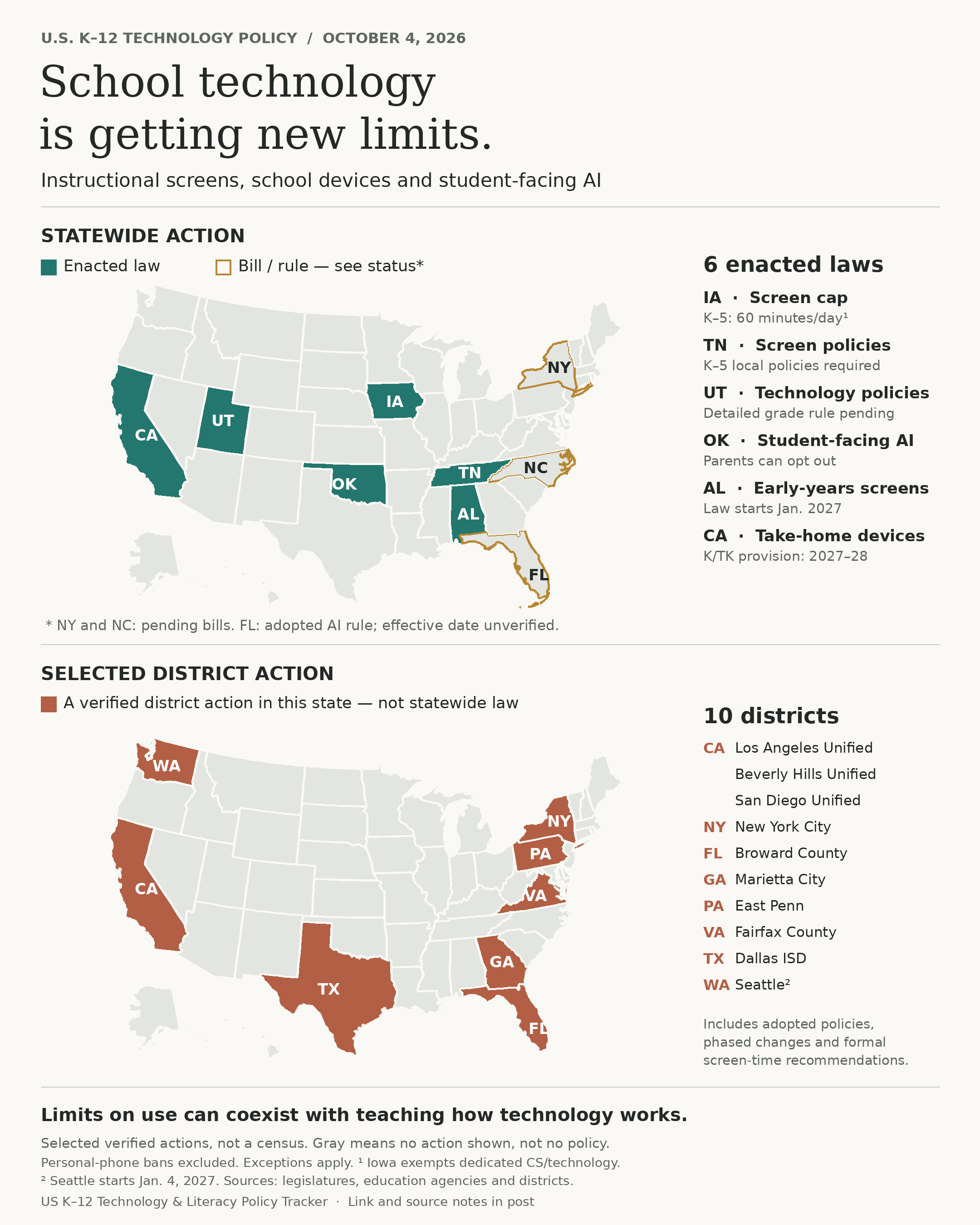
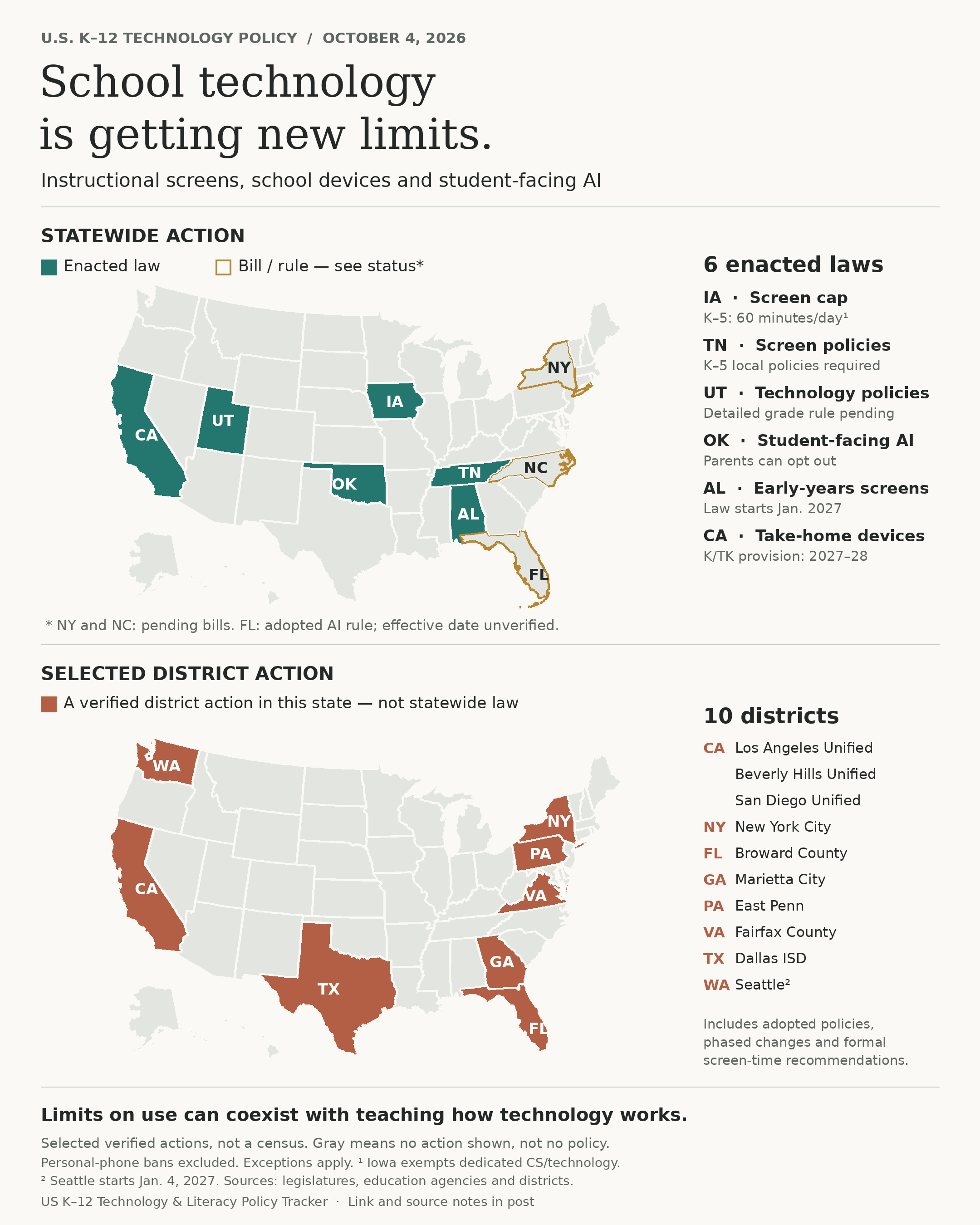
Instructional screens, school-provided devices and student-facing AI. Selected verified actions, with their dates and limits made visible.
The image separates statewide action from district action. It includes future requirements and formal district recommendations; these are not all bans, and the selection is not a national census.
Read the evidence behind the image
Enacted laws, proposed rules, district requirements and recommendations remain separate. A blank historical finding is unknown, never a confirmed absence.
AL · State · SCREEN
Act 2026-169 / HB78
Enacted; future effective
Public kindergarten included in early-childhood framework; prohibits passive/background screen media and requires age-appropriate standards. No numeric kindergarten cap in the act.
Adoption / announcement: 2026-03-04
Applies: 2027-01-01; kindergarten local policies by 2027–28
Exceptions: IEP, 504, health plan; required kindergarten tests; approved virtual programs
Read the primary source
Audit note
Separate K–12 screen commission is not a restriction. Signing: https://governor.alabama.gov/newsroom/2026/03/governor-ivey-signs-screen-time-limits-for-early-childhood-education-programs-into-law/
CA · State · DEVICE
SB1128 / Chapter 191
Enacted; provision applies later
LEAs may not require kindergarten, including TK, to take home school-issued devices.
Adoption / announcement: 2026-09-10
Applies: 2027–28 school year
Exceptions: IEP, emergency and independent-study exceptions; not a ban on every take-home device
Read the primary source
Audit note
Final legislature text could not be retrieved; narrow mapped claim relies on official post-signing Senate summary. Governor signing: https://www.gov.ca.gov/2026/09/10/governor-newsom-signs-the-strongest-child-safety-chatbot-and-social-media-laws-in-the-nation/
IA · State · SCREEN; DEVICE
HF2676 / Acts Chapter 1129
Enacted
K–5 digital instruction limited to 60 cumulative minutes/day; local technology-use policy; checklist before adoption or renewal of 1:1 programs.
Adoption / announcement: 2026-05-20
Applies: 2026–27 implementation; see DOE FAQ
Exceptions: Assistive/adaptive and IEP/504; teacher displays without student devices; required assessments; dedicated CS/technology curriculum; online programs
Read the primary source
Audit note
Signed act: https://www.legis.iowa.gov/docs/publications/iactc/91.2/CH1129.pdf. A 1:1 adoption checklist is not a 1:1 ban.
OK · State · AI
SB1734
Enacted; effective
Student-facing AI subject to educator direction; parents may opt students out without academic penalty or loss of core content.
Adoption / announcement: 2026-05-12
Applies: 2026-07-01; local policies before 2027–28
Exceptions: Does not prohibit AI generally or require its use
Read the primary source
Audit note
Approval verified in official status: https://www.oklegislature.gov/BillInfo.aspx?Bill=SB1734&Session=2600
TN · State · SCREEN
HB2393 / SB2310 / Public Chapter 808
Enacted; effective
LEAs and charters must adopt K–5 instructional-device policies minimizing unnecessary screen time.
Adoption / announcement: 2026-04-21
Applies: 2026-07-01
Exceptions: Targeted interventions; accommodations; assessments; teacher preparation; virtual/homebound/remote instruction
Read the primary source
Audit note
Original proposed device ban was amended. No universal numerical cap in the enacted requirement.
UT · State · SCREEN; AI
HB273
Enacted; policy implementation later
Requires purposeful instructional technology, minimized nonessential screen time and balanced technology/AI policies.
Adoption / announcement: 2026 legislative session
Applies: 2026-07-01; local policies before 2027-07-01
Exceptions: Instructional, accessibility and specialized uses depend on statute and implementing policy
Read the primary source
Audit note
Official USBE summary pp.19 and 44–45. Detailed grade rules are recorded separately below; not presented as operational.
UT · State · SCREEN; DEVICE; AI
Proposed R277-334
Proposed implementing rule
Proposed K–3 screen restrictions; K–6 no required 1:1 or take-home devices; older-grade consent; approved AI rules.
Adoption / announcement: Notice 2026-09-01
Applies: Earliest anticipated 2026-10-08, NOT an effective date
Exceptions: CS, testing, subject-integral technology, virtual instruction, tribal provider, IEP/504 and other listed exceptions
Read the primary source
Audit note
Bulletin pp.57–64 (PDF pp.63–70). Enacted HB273 and proposed rule are distinct records.
NY · State · SCREEN; DEVICE
S10685 / FOCUS Act
Active bill; in Rules Committee
Would restrict younger-grade internet-enabled devices, favor carts/labs and require caregiver opt-in for assigned devices in older grades.
Adoption / announcement: Introduced 2026-08-21
Applies: Not law
Exceptions: Proposed statutory exemptions; not operational
Read the primary source
Audit note
Official page explicitly marks ACTIVE. Do not treat NYC policy as state law.
NC · State · SCREEN; DEVICE
S948 / Screen Free Schools Act
Bill in Appropriations/Base Budget; not enacted
Proposes instructional screen limits and parent options for reduced or no device use.
Adoption / announcement: Introduced 2026-04-30
Applies: Not law
Exceptions: See filed bill; no operational requirement
Read the primary source
Audit note
Last action 2026-05-04. Appropriations bill in 2025–26 session; pending classification is not a prediction of passage. Text: https://www.ncleg.gov/sessions/2025/bills/senate/html/s948v1.html
FL · State · AI
Rule 6A-1.0957 AI amendment
Board-adopted; effective date not verified
Adopted amendment addresses parental choice, younger learners and bans companion-style AI in classrooms.
Adoption / announcement: 2026-09-16 board adoption
Applies: Not verified in force at cutoff
Exceptions: Educational uses subject to age-appropriate review; non-AI alternatives
Read the primary source
Audit note
Official FAC record still shows 2023 as latest final rule, with Sep18,2026 change notice: https://flrules.org/gateway/ruleNo.asp?id=6A-1.0957 . Shown separately from laws; do not call operative.
CA · District · SCREEN; DEVICE
Los Angeles Unified
Adopted; phased implementation
Early education–grade 1 default zero screen minutes and no individual assigned device; grade caps and take-home defaults in implementation matrix.
Adoption / announcement: 2026-04-21 resolution
Applies: EE–grade 1 Aug. 2026; grades 2–5 Nov. 2026; grades 6–12 Jan. 2027
Exceptions: Required assessments, IEP, Virtual Academy; instructional exemptions and parental options in matrix
Read the primary source
Audit note
Map uses verified screen/device action. Reported 2026 AI moratorium is not used as a verified map claim.
CA · District · SCREEN; DEVICE
Beverly Hills Unified
Adopted
TK–2 no assigned 1:1 devices; technology limited to assessments, teacher-led activities and required accommodations.
Adoption / announcement: Announced 2026-07-15
Applies: 2026–27 framework
Exceptions: Teacher-led activities, required assessments, legal accommodations; later grades expand technology/AI literacy
Read the primary source
Audit note
Official release describes later AI-literacy work; do not equate literacy with permission for unrestricted AI use.
CA · District · SCREEN; DEVICE
San Diego Unified
Adopted; implementation announced
Removes TK computer carts; developmentally appropriate use changes; student-direct YouTube access restricted.
Adoption / announcement: 2026 board action; official update Aug3
Applies: 2026-08-10 school year start
Exceptions: Teachers can show/embed videos; disability and language-learning exceptions
Read the primary source
Audit note
Map inclusion rests on TK device change, not generic filtering alone.
NY · District · SCREEN; DEVICE; AI
New York City Public Schools
Adopted; 2026–27 guidance
2K–8 student-facing GenAI moratorium; 2K–2 no 1:1 screen use; grades 3–5 recommended 30 min/day, grades 6–8 recommended 45 min/day.
Adoption / announcement: 2026-09 announcement
Applies: 2026–27 school year
Exceptions: Assistive technology/accommodations; tests, coding, robotics, simulations and other approved educational uses
Read the primary source
Audit note
All high-school students also assigned two 45-minute AI-literacy modules. Recommendations are not absolute caps; high-school AI access remains restricted to approved uses.
GA · District · SCREEN
Marietta City Schools
Board resolution adopted; implementation developing
Screens closed by default and opened with purpose; no screen use for behavior management; age-appropriate technology/AI expectations.
Adoption / announcement: Official announcement 2026-07-15
Applies: 2026–27 strategy and phased implementation
Exceptions: Purposeful teacher-directed instructional use; not a universal minute cap
Read the primary source
Audit note
Resolution direction is distinguished from completed implementation.
PA · District · DEVICE
East Penn School District
Announced district policy
Elementary district devices and chargers remain at school; student-device YouTube removed.
Adoption / announcement: 2026-08-18
Applies: 2026–27 school year
Exceptions: Teacher use of video remains possible; accommodations governed separately
Read the primary source
Audit note
2024 source: https://www.eastpennsd.org/article/east-penn-adopts-policy-on-ai-use-for-student-learning/
WA · District · SCREEN; DEVICE
Seattle Public Schools
Announced; future implementation
K–2 moves from assigned 1:1 iPads to shared classroom devices; generally 0–30 minutes/day.
Adoption / announcement: 2026-09-21
Applies: 2027-01-04
Exceptions: Approved instruction and required accommodations; screen use is not required
Read the primary source
Audit note
Future date explicitly marked in image. Current announcement is not evidence change already occurred.
VA · District · DEVICE; AI
Fairfax County Public Schools
Board action adopted
No FCPS-issued tablets/laptops in pre-K and kindergarten; student GenAI unavailable in elementary; secondary use needs principal authorization pending policy.
Adoption / announcement: 2026-07-16
Applies: Fall 2026
Exceptions: Required accommodations; authorization provisions for secondary uses
Read the primary source
Audit note
Official board-member bulletin. Further proposed changes discussed in meetings are not treated as adopted.
FL · District · AI
Broward County Public Schools
Policy adopted; current tool restrictions
Only approved student AI tools; no student-facing AI tool currently approved for K–5; secondary tools limited to approved uses.
Adoption / announcement: 2026-09-15
Applies: Current district AI hub at cutoff
Exceptions: Teacher-led lessons about AI differ from students interacting directly with AI
Read the primary source
Audit note
Primary hub links policy7540.08. Current approved-tool list governs; older snippets mentioning a broader rollout are not used.
TX · District · SCREEN
Dallas ISD
Implemented district guidelines; recommended limits
Daily recommendations: preK–2 60min; grades 3–5 90min; grades 6–8 120min.
Adoption / announcement: 2026-09-01
Applies: 2026–27
Exceptions: High-school use varies with academic pathways; teacher-led instruction emphasized
Read the primary source
Audit note
Official article calls these recommendations despite a quoted reference to strict limits. Image does not label them enforceable caps.